Skip to:


Search
Good evening, everyone.
Firstly, I’d like to acknowledge the Traditional Owners of the land on which we meet today and pay my respects to Elders past and present.
I’d also like to sincerely thank Sacred Heart Mission for inviting me to speak today, and for creating spaces where people with lived experience aren’t simply invited into the room—they’re genuinely listened to.
Because that’s where real change begins.
People often say that homelessness ends when someone receives a roof over their head. I understand why people think that.
A key is handed over. A lease is signed. The paperwork says the person is now housed. There are four walls, a front door and somewhere to sleep.
But for many of us with lived experience, that’s not the end of the story. It’s the beginning of an entirely new chapter.
A house alone doesn’t erase trauma.
It doesn’t rebuild confidence. It doesn’t restore trust. And it doesn’t automatically make someone feel safe.
If trauma isn’t considered when housing people, we risk creating another set of challenges.
We would never place someone who uses a wheelchair in a third-floor apartment with no lift and expect them to succeed. Yet we often overlook invisible disabilities. PTSD. Complex trauma. Anxiety. Depression. ADHD.
These conditions affect how people experience the world, how they build relationships, and whether they feel safe enough to recover. They deserve to be considered just as carefully as physical accessibility.
Because a house doesn’t automatically become a home.
A home is somewhere you can finally walk through the front door after facing the world all day, take a deep breath and think…”I’m safe now.”
That’s when you begin planning for tomorrow instead of simply surviving today.
When someone has experienced family violence, or violence in the community, assaults, homelessness, years of trauma, medical complications, or multiple surgeries…
You can understand why rebuilding self-esteem and confidence isn’t something that happens overnight.
Where we place people matters.
Because safety matters. Neighbourhoods matter. Community connections matter. Access to healthcare matters. Support services matter. And most importantly… the individual matters.
Every one of those decisions can determine whether someone continues moving forward—or ends up back where they started.
We already collect enormous amounts of information. We collect crime statistics. Emergency service data. Community profiles. Housing information.
The challenge isn’t whether the information exists. The challenge is whether we’re using it effectively when matching people with housing.
Instead of only asking, ‘Is there a vacant property?’, perhaps we should also ask:
Because good housing isn’t simply about filling vacancies. It’s about giving people the greatest possible chance to succeed.
Australia provides significant tax concessions to encourage private property investment. Those policies have their purpose, and many people have worked incredibly hard to build those investments.
At the same time, thousands of Australians still sleep rough or experience homelessness every night.
The Australian Government invests billions of dollars each year into homelessness and housing programs. The question isn’t simply whether money is being spent. The question is whether we’re investing enough in the right places and at the right time. Because every dollar spent preventing homelessness or supporting recovery often saves many more dollars responding to crisis later.
Most importantly, it saves lives.
When someone is offered housing, are we asking the right questions on their behalf? Or are people simply expected to accept the first available property because they’re told they should be grateful?
Why, in a country like Australia, are people still waiting years—sometimes decades—for safe and appropriate housing?
Housing should create opportunity. Housing should create stability. Housing should create safety. Not simply fill an available property on a spreadsheet.
Recovery doesn’t happen according to funding cycles. Six months of support might work for some people. But for many others, it simply isn’t enough.
What happens when appointments become less frequent, and suddenly the person who helped you navigate life isn’t there anymore?
The period immediately after someone is housed can actually be one of the most vulnerable times in their recovery.
Imagine spending months or years sleeping rough. Couch surfing. Living in temporary accommodation. Operating in survival mode every single day.
Then one day someone hands you the keys to a house. It’s an incredible moment.
But nobody hands you an instruction manual on how to rebuild your life. Nobody teaches you how to trust again. Nobody teaches you how to overcome the anxiety of answering the front door. Nobody teaches you how to rebuild confidence after years of trauma.
Sometimes you’re relocated far away from your doctor. Far away from your support network. Far away from the only community you’ve ever known. Months later you still haven’t made those phone calls because anxiety wins every single time you pick up the phone.
Loneliness doesn’t disappear overnight. Fear doesn’t disappear overnight. Trauma doesn’t disappear overnight.
Many people suddenly find themselves living completely alone after years of constantly being surrounded by others. That isolation can become overwhelming.
Support needs to remain available until people have genuinely settled into their communities and can finally experience something many of us take for granted… the peace of climbing into bed at night knowing you’re safe. That’s an incredible feeling. Everyone deserves to experience it.
Sometimes people don’t need someone to solve every problem. Sometimes they simply need someone to ask, “How are you really going?”
Those conversations can prevent crises before they happen. They’re also far less expensive than responding after everything has fallen apart.
Early support isn’t just compassionate. It’s good policy. It’s good economics. And above all, it’s good humanity.
Not because we have all the answers. We don’t. But because we’ve lived through parts of the system that reports and statistics can never fully explain.
We know what it’s like to fall through the cracks. We know what helps. And we know what unintentionally causes harm.
That’s exactly what the EAGLE program represents. It says that lived experience isn’t something to hide. It’s expertise. It’s evidence. It’s knowledge.
For years many of us were defined by our worst moments. Today we’re helping shape better futures for other people.
Think about that for a second.
Five years ago, I came frighteningly close to ending my own life. Today I’m standing here speaking to a room full of people committed to improving the lives of others.
That transformation didn’t happen because of one program. It happened because people didn’t give up on me. Workers kept listening. They kept believing. They kept showing up.
Today, through EAGLE, we’re helping shape policies, language and services that improve outcomes for future participants. One simple example is the language we use. We no longer speak about ‘customers’. We speak about ‘participants’. That small change reminds us we’re talking about people—not transactions.
When organisations genuinely listen to lived experience, services improve. Policies improve. Relationships improve Trust grows. Because decisions become grounded in reality instead of assumptions.
I’d like to sincerely thank Sacred Heart Mission for recognising the value of lived experience and giving people like me a genuine voice. Not every organisation does. But I hope many more will.
People with lived experience don’t expect perfection. We know systems are complex. We know resources are limited. We know frontline workers carry enormous workloads. We know everyone is trying to do the best they can.
But listening costs very little. Sometimes listening changes everything.
Often the person living the experience notices risks long before anyone else. Those observations shouldn’t be dismissed as complaints. They should be recognised as valuable evidence. Because prevention will always be easier than recovery.
Firstly, continue advocating for housing that is matched to people’s individual circumstances, health and disabilities—not simply availability. Make safety part of every housing conversation.
Secondly, recognise that receiving housing isn’t the finish line. Recovery takes time. Healing takes time. Long-term, flexible support gives people the greatest opportunity not just to survive—but to thrive.
Thirdly, embed lived experience at every level of decision-making. Not as a token voice. Not after the decisions have already been made. But alongside executives, finance teams and boards as genuine partners from the very beginning.
Finally, let’s measure success differently. Don’t simply count how many people were housed.
Count how many felt safe. Count how many stayed connected. Count how many rebuilt relationships. Count how many found employment. Count how many rediscovered hope. Because those are the outcomes that truly change lives.
But homelessness is much more than that. It’s losing certainty. Losing safety. Losing connection. Sometimes even losing your sense of identity.
Housing helps restore those things. Recovery restores the person. That’s why both matter.
Before I finish, I’d like to leave you with one final thought.
Every policy, every funding decision, every housing allocation, every support program, eventually becomes somebody’s everyday life.
Not a statistic. Not a report. A real person. Someone’s son. Someone’s daughter. Someone’s parent. Someone’s best friend. Someone who wants exactly what every one of us wants.
To feel safe. To belong. To have somewhere to call home. And to believe that tomorrow can be better than today.
I genuinely believe we’re moving in the right direction. Programs like EAGLE give me hope because they prove organisations are willing to listen. But hope shouldn’t make us comfortable. Hope should motivate us. Because while we’ve come a long way, there is still more to do.
If we continue listening, continue learning, continue working together, and continue placing lived experience at the centre of decision-making…
I truly believe we can build a homelessness system that doesn’t just house people. It helps people heal.
Thank you.
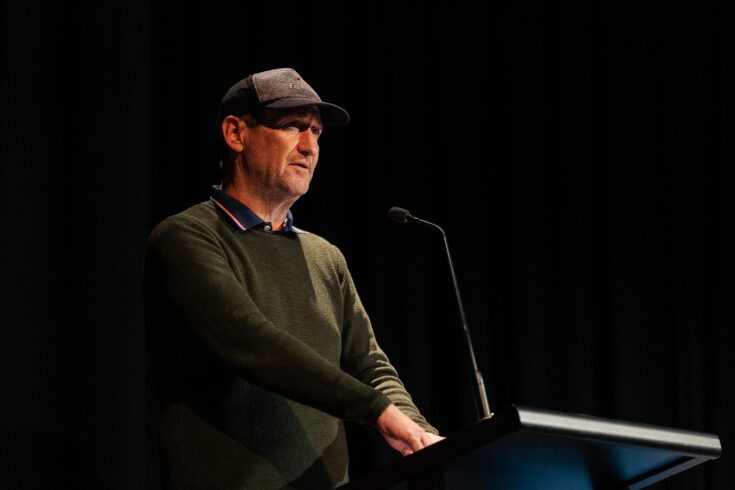
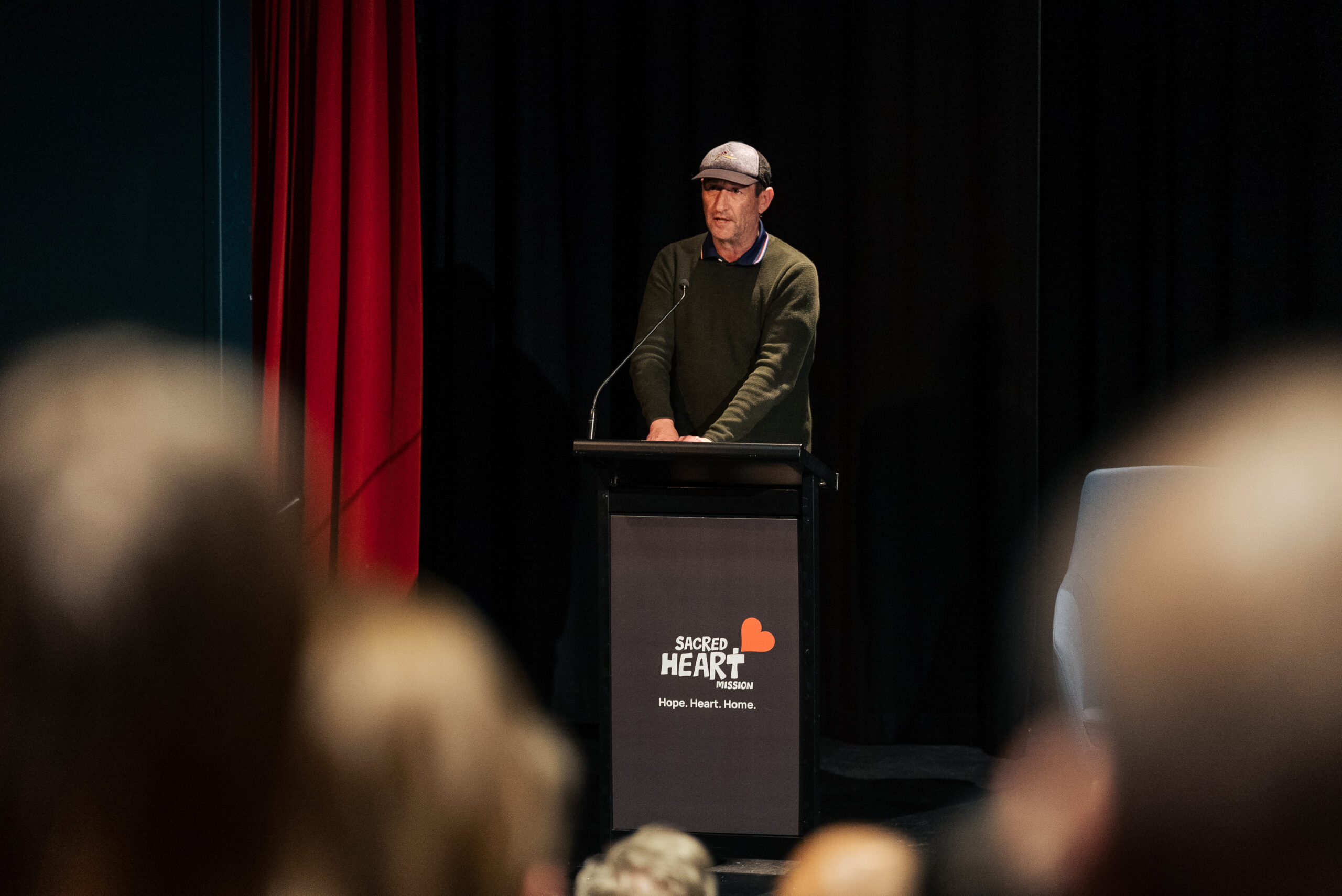
Chris Reid is a founding member of Sacred Heart Mission’s lived experience advisory group. His diverse career as a bank manager and state cricket coach/player came to an abrupt end after a hip replacement, followed by a violent home invasion. He endured years of homelessness and unsafe housing, and these experiences have fuelled his passion to speak up about safer housing, mental health support, and continuity of care.
What happened at the Advocacy Forum?
Keynote address from Catherine Aloise
Stay up to date with our monthly newsletter, Heartbeat