Skip to:


Search
As Victorians, we believe that everyone deserves to feel safe, connected and at home. Yet housing demand continues to exceed supply, so people find themselves in temporary or unsafe housing and, in many instances, sleeping rough in public spaces.
The incredible and overstretched specialist homelessness services currently available are not set up to deal with the complex and challenging issues that contribute to, and arise from, experiences of being unhoused. These disadvantages include persistent homelessness, experiences of family violence, untreated mental ill-health, racism, misogyny, lack of disability supports, abuse, histories of being in state care, interactions with law enforcement and the criminal justice system.
Through Sacred Heart Mission’s Strategy 2030, we are committed to advocating for systemic change and whole-of-government responses to ensure homelessness is truly rare and non-recurring. With more than 40 years of experience supporting our local community, we have seen how gaps in policy and services negatively impact people already experiencing significant disadvantage.
We are members of the Council to Homeless Persons (CHP), Victorian Council of Social Services (VCOSS) and Catholic Social Services Victoria (CCSV), Mental Health Victoria (MHV) among other peak bodies. Together with our First Nations partners and sector organisations, we work towards fairer, more transparent housing policies that better meet Victorians’ needs.
Our election priorities reflect shared concerns across the sector and the perspectives of workers, volunteers and people with lived and living experience. We want Victoria to continue to be a welcoming place where everyone can access the support they need, where First Nations communities are respected and supported, and where people from all walks of life are met with understanding.
At Sacred Heart Mission, we are hopeful that we can work with our people, our sector, our communities and the next Victorian government in a collaborative and generative way. Ensuring that those who bear the brunt of policy decisions are supported to live meaningful and connected lives that are genuinely respected and valued.
As a frontline service, we join our sector, workers, volunteers and participants in calling for housing to be treated as a human right, not a commodity, so every Victorian can lead a connected and fulfilling life.
We call on the 61st Victorian Government to commit to the work we’re already doing, support people while they wait for housing and provide the community with a way to support those who are currently unhoused and in need of assistance.
We join with our peaks and ask the next government to commit to building 80,000 social homes over ten years, while helping people keep a home through supportive housing.
Supportive housing combines ongoing housing with wraparound support to help people maintain their tenancies and rebuild their health and wellbeing. Sacred Heart Mission’s Journey to Social Inclusion (J2SI) program is one example of this longer-term support.
The results show it works: 90% of J2SI participants maintained their tenancies 12 months after the program ended, with economic returns of $2.20 for every $1 invested. Wraparound support empowers participants while reducing government expenditure.
Housing must be accompanied by ongoing support from an appropriately skilled, trained and resourced workforce. This includes Aboriginal housing and Aboriginal and Torres Strait Islander-led services, as well as funding that allows services to plan and ensure that case management and allied services can respond to participants’ needs and the interconnected challenges they face.
Once housed, most people need wraparound support to maintain their tenancies and achieve the goals they have set for themselves. Programs like Journey to Social Inclusion and the Rooming House Plus Program must include coordinated support services, including mental health, alcohol and other drugs, family violence responses, and wellbeing support, all underpinned by intensive case management.
These programs would then provide a comprehensive statewide supportive housing strategy that could be replicated and modified to respond to the unique needs of participants in metropolitan and regional areas nationally.
Engagement hubs are places where people experiencing homelessness or at risk of homelessness can get practical urgent assistance, community connection and coordinated support, all under the same roof.
The doors are open 365 days of the year, and people arrive seeking support for everyday essentials such as meals, clothing and showers. Many of the people who come in for a hot coffee or a nutritious breakfast stay for the social interaction and sense of community they feel, then return for ongoing support and referrals to other services.
Some people seek support within a day or two; for others, it can take months. These small, repeatable moments of connection build trust over time.
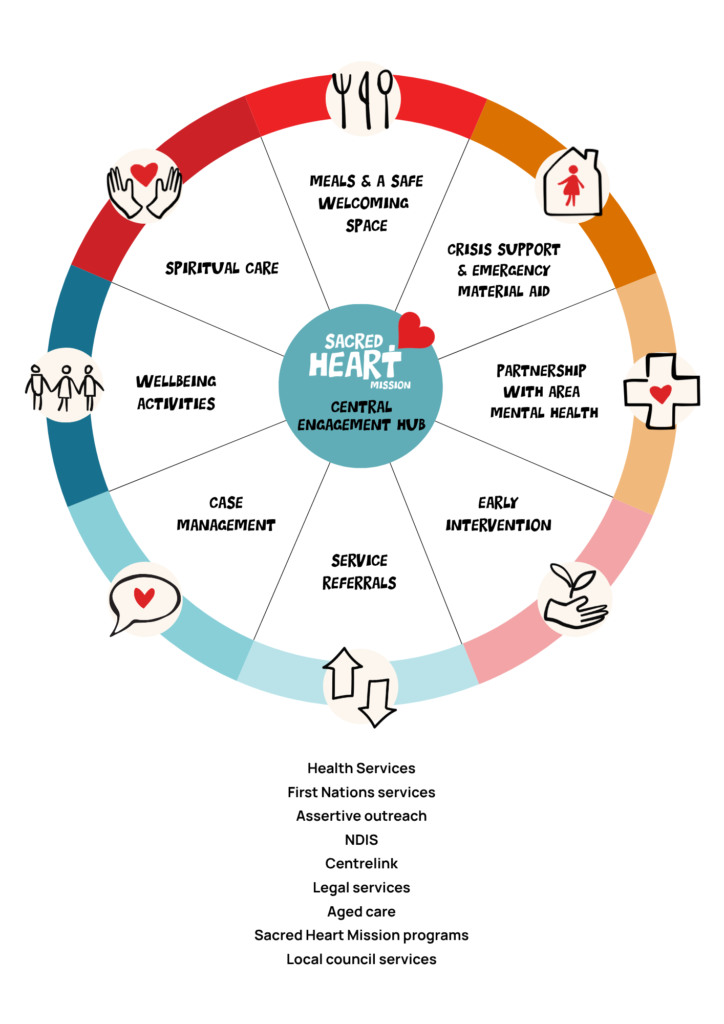
We want government to recognise engagement hubs as critical, low-barrier components of the specialist homelessness services network. While we wait for housing, engagement hubs offer immediate crisis support, material aid, meals and referrals to required services, while providing participants with a place they can return to without being asked to move on.
The hubs provide on-the-spot assessments without paperwork or identification requirements, creating opportunities for early intervention. They complement assertive outreach, serving as both a conduit and a physical place where people can connect with services, pathways and case management workers.
Together, these supports help participants access what they need while providing much-needed community, connection and belonging. Hubs, together with connected support services, can help ensure that experiences of homelessness are rare and non-recurring.
Hubs should complement, not replace, investment in housing supply.
Learn more and support First Nations organisations and their right to self-determine their futures.
Have considerate, meaningful conversations with the people in your life about key issues. You may wish to explore:
a. The top three reasons Victorians sought specialist homelessness assistance in 2024–25 were financial difficulties (46%), family and domestic violence (42%) and housing affordability stress (37%). (AIHW, 2024–25 Victoria fact sheet).
b. Since 2022, median rents have increased by 40% in metropolitan Victoria and 26% in regional Victoria. This puts further pressure on households already struggling to afford housing. (Anglicare Victoria, Rental Affordability Snapshot 2026).
c. Social housing makes up just 3% of Victoria’s housing stock, the lowest proportion of any Australian state or territory. In March 2025, 66,117 households were waiting for social housing, including 37,438 on the priority list. This represented an increase of more than 7% in a year. (AIHW, 2026; CHP, Housing Insecurity Index 2025).
d. Homelessness is not just about unemployment. In 2023–24, 13,715 employed Victorians sought specialist homelessness assistance, an increase of 23.5% over five years. (CHP, Housing Insecurity Index 2025; AIHW).
a. People are the experts in their own lives and decide what support they want. Past trauma, abuse, contact with child protection or the criminal justice system, and unmet mental health or disability support needs can make people wary of mainstream services. We can’t assume we know what someone has been through.
b. Specialised homelessness sector (SHS) services are available, but many are struggling to meet demand. A recent Victorian Homelessness Network survey found that almost 70% of entry points had closed their doors because of capacity constraints and staff shortages. Eighty per cent could not assist single adults without dependants. Services can provide vital support, but they cannot provide housing that doesn’t exist.
a. Start from a place of respect and listen without judgement. Ask what would be helpful rather than making assumptions.
b. If they ask for food or water and you have the means, please help, especially as the weather warms up.
c. If they need more support, you can contact the Victorian Statewide Homelessness Line on 1800 825 955 for advice. You can also Ask Izzy, which lists local homelessness, food, health and other support services.
Get in touch with our communications team to learn more about our election asks at communication@sacredheartmission.org or come and say hello at our central office at 71 Robe Street, St Kilda.
Stay up to date with our monthly newsletter, Heartbeat